Blockchain research · Analysis
How to index token events when blocks can be replaced
Give token logs stable identities, reconcile the current canonical block sequence, and keep payment marks consistent after interruptions.
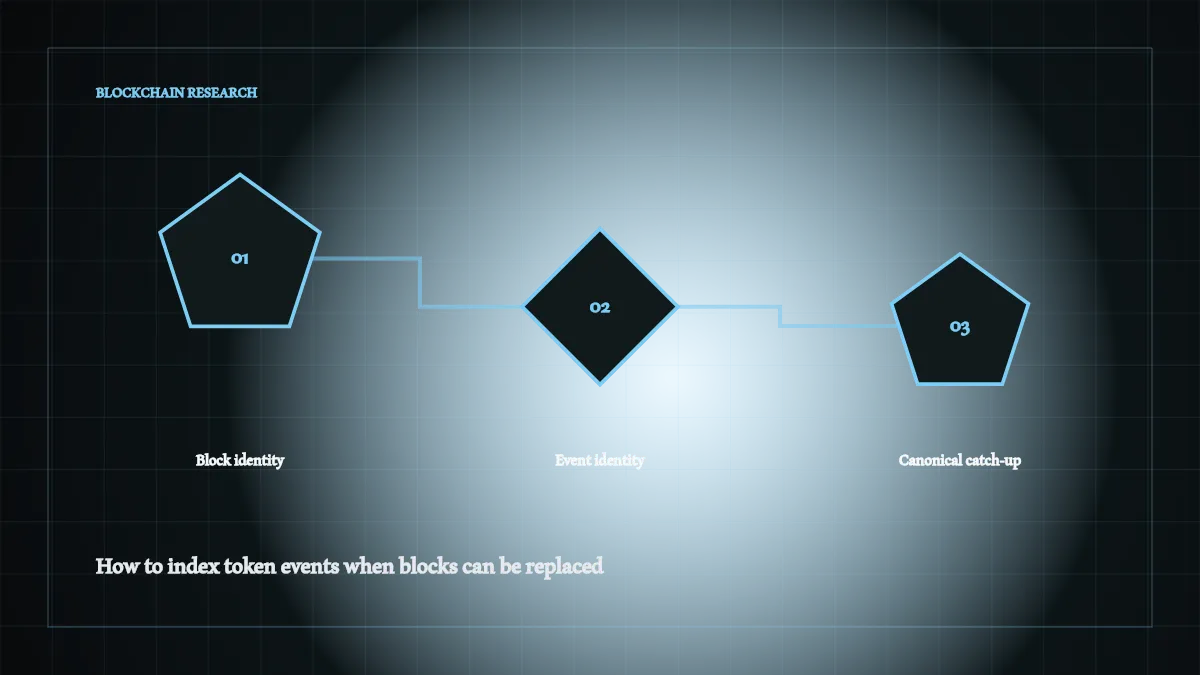
A log listener records a deposit, briefly loses its connection, and reconnects. Treating the stream as a guaranteed ledger leaves an awkward question: was a record sent twice, missed during the outage, or moved out of the observed chain history?
Record the context of each observed event
Event logs expose identifiers such as the block hash, transaction hash and log position. Store the chain and the block identity alongside the log. Filter by the emitting contract and expected event when looking for an ERC-20 transfer.
Source · Ethereum.org JSON-RPC methods and receipt format · Ethereum ERC-20 token standard
Resume by checking the observed history
Persist a checkpoint and compare the block at that checkpoint with the current chain. After a gap or divergence, query the affected block range and reconcile missing or replaced events. Stream notifications can make an index responsive, while range queries give it a recovery path.
Model downstream credit explicitly
Separate index events from balance changes. Make the credit operation idempotent using a business reference, define the network-specific assurance rule, and route exceptions or reversals through an auditable path. An event record should retain enough data to explain why credit was recorded.
What to take away
Test disconnect, replay and changed block history as first-class cases. A green receipt in a demo cannot establish that the index stays correct through a recovery.