Automation & agents · Analysis
How to keep public-source research separate from agent permissions
Design a research workflow so a public page can contribute evidence while privileged actions remain governed by the application.
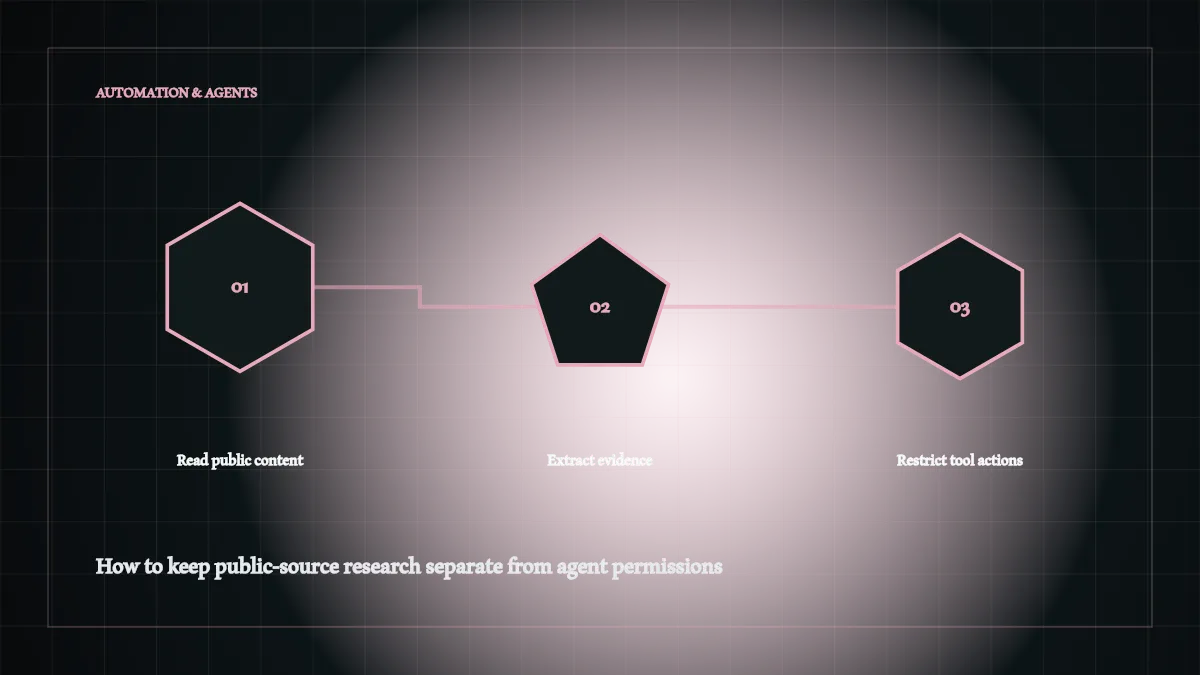
A research assistant reads press releases and changelogs. The same run can also create a draft in a private CMS. The easiest way to review this design is to follow each piece of external text and see which application actions it can influence.
Label retrieved content as evidence
Keep source URL, publisher and fetched time with every excerpt. Ask the extraction step for bounded fields such as announcement date and described change. Validation decides which fields move forward. The workflow should preserve evidence even if extraction cannot establish a fact.
Source · Anthropic · Writing effective tools · NIST · AI Risk Management Framework
Apply permissions at the action boundary
Give source readers the minimum read access and a separate account or stage to write drafts. The application checks actor, target and operation before actions. Use review for publication and keep a record of the decision.
Source · MCP · Tool specification · NIST · AI Risk Management Framework
Exercise the boundary
Use a synthetic document containing irrelevant editorial directives. Check that source text still arrives as study material, and inspect the CMS audit log for unintended edits or publish events.
Source · MCP · Tool specification · Anthropic · Writing effective tools
What to take away
Review the evidence path and the action path together so a useful source cannot expand the agent’s authority.