Automation & agents · Analysis
When a router beats an AI agent
A support-routing example shows where a fixed workflow helps and how to find the cases that actually need an agent.
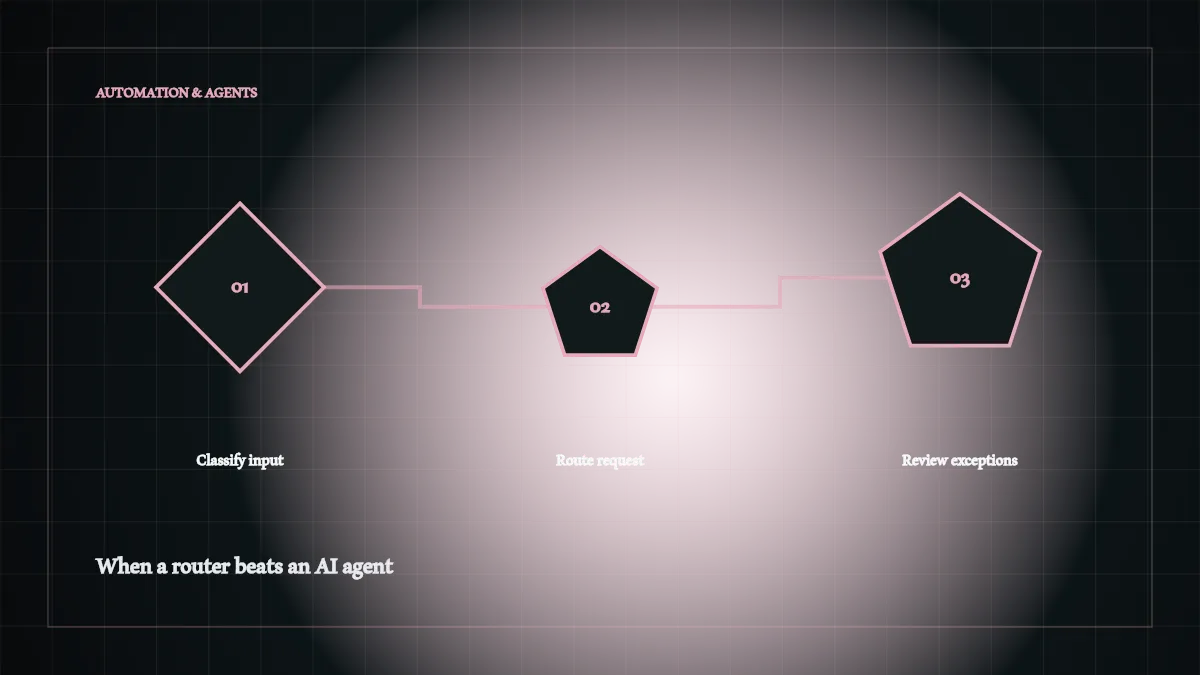
A merchant sends a message about a payment, an account lock and a refund in the same paragraph. The first useful job is to recognize that it needs two owners and a decision queue. Giving a general agent permission to resolve all three problems introduces a far larger product surface.
Put the fork in the workflow
Anthropic’s distinction between workflows and agents is useful here: in a workflow the application chooses the path, while an agent can choose how to use tools. A classifier can return payment, access, refund or ambiguous. The product then maps that label to an owner.
Send ambiguous cases somewhere useful
Use a small set of mixed-intent messages as tests. Check whether all required queues received the case and whether any customer record changed. If a refund is only mentioned, the correct result may be a question rather than a draft refund.
Review the execution result
Assess the assigned queues and the recorded status. A polished reply saying the case was assigned offers limited evidence unless the queues actually contain it.
Source · Anthropic · Agent evaluations
What to take away
Start with one routing decision, then add autonomy at the point where observation shows that fixed paths repeatedly fail.