Automation & agents · Analysis
How to keep a bilingual article accurate after an update
Link translations to shared facts and source revisions so a correction reaches both language versions without flattening the writing.
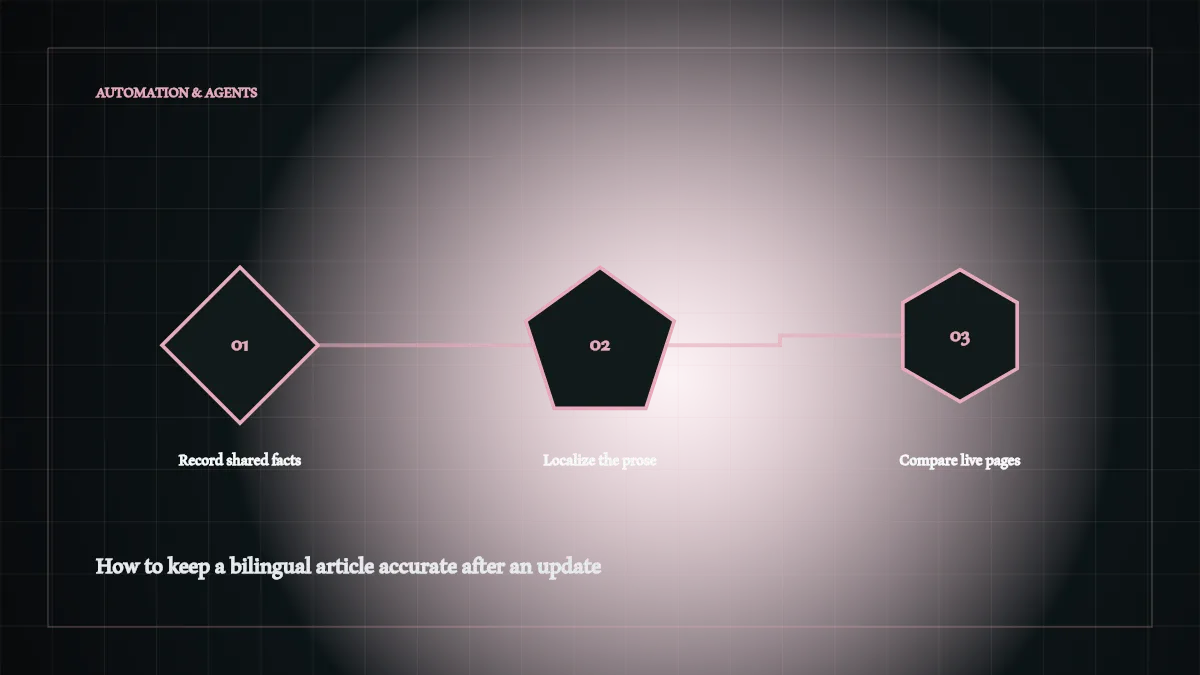
An article about an exchange feature is correct in English after an update. The Persian page still says the feature is live in every region. The translation had its own draft and never received the correction.
Share the facts that require parity
Keep a small set of canonical facts such as effective date, market coverage, source URL and units. Store context for each field. A date can display in two calendars while both versions still identify the same day.
Source · Google Search Central · Helpful content · Google Search Central · Generative AI content
Translate for the reader
Let each language explain a term the way its audience uses it. Keep qualifiers such as limited rollout or testnet in the corresponding sentence. Review a screenshot’s embedded text if the UI offers different language or regional settings.
Treat updates as a two-page review
Identify which claim changed, what source revision supports it and which pages are still outstanding. Open both public URLs and compare the affected paragraph and date. Where publication is staggered, use the editor’s status to avoid silently indexing a known inaccurate draft.
Source · Google Search Central · Helpful content · Google Search Central · Generative AI content
What to take away
Tie the two pages to the same evidence revision while giving each language its own editing and review.