Applied AI · Guide
A release test for model answers that change across runs
Measure whether critical behavior survives repeated runs, record settings and model versions, and distinguish brittle items from healthy output variety.
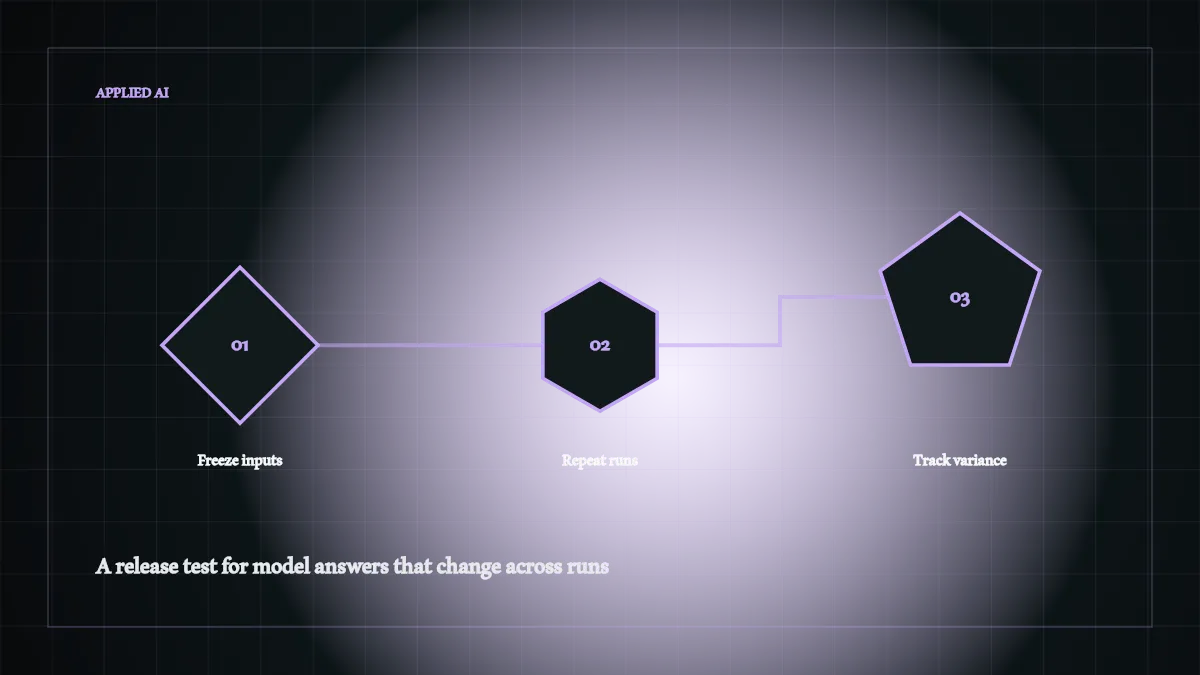
A test passes on Monday and fails on Tuesday with the same input. A single retry can hide a risky task or reveal a harmless change in phrasing. A release test should identify which kind of variation a team is seeing.
Freeze what you can reproduce
Record model version, task inputs, system prompt, sampling configuration, and tool results in a small test. If the workflow uses current search results, save a test fixture for repeatability and run an additional live check for freshness. Separate failures in the model from changes in its inputs.
Source · OpenAI API — Evaluation best practices · OpenAI API — Model optimization
Repeat by item and score the critical fields
For a support assistant, exact wording may vary while the next required action and eligibility rule stay fixed. Run each tricky case several times under a declared budget. Report the distribution and list items that sometimes failed. Include refusals and timeouts in the outcome counts.
Source · Liang et al. — Holistic Evaluation of Language Models
Decide what warrants a release hold
Classify failures like wrong amounts or unsupported promises separately from formatting changes. Choose a gate using the consequence of failure and the confidence supported by the current sample. Add any newly brittle cases to the tracked set and rerun the candidate and baseline under the same conditions.
What to take away
Repeated test results give the product team a view of reliability at the task level and show which examples need the next investigation.