Applied AI · Analysis
How to read an AI time-horizon benchmark
Understand why a 50% task-completion horizon describes human task duration and a modeled chance of success.
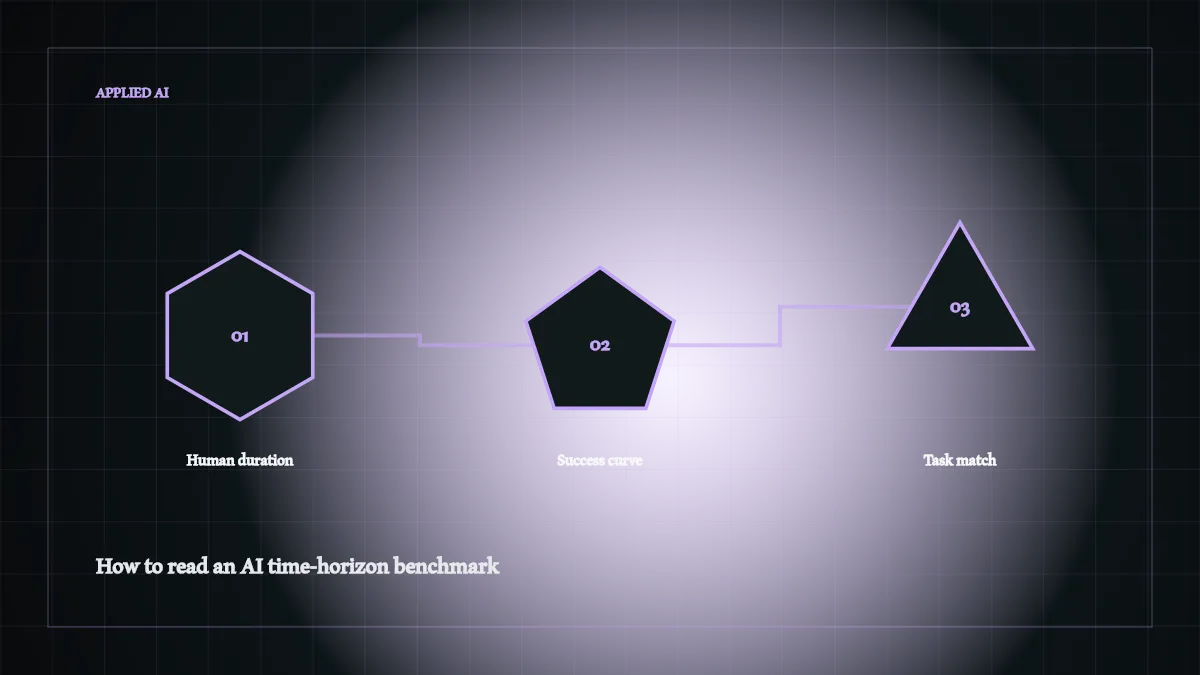
A chart puts an AI at a four-hour horizon. A reader might assume the system ran for four hours or can handle a half-day of work unsupervised. METR’s definition is more specific, and it changes how to use the chart.
The horizontal axis is an expert’s time
The task duration used by METR is how long a human expert takes. The 50% horizon is the point on a fitted curve at which the model is predicted to succeed half the time on the suite. A higher probability target describes a more demanding reliability condition.
Source · METR — Time Horizons 1.1 methodology
What the task suite can represent
Read the task inventory, evaluation harness and success criteria before applying a headline horizon to your domain. A task with checkable software output has a different acceptance test from advising a customer with an incomplete record. Confidence intervals and task coverage both belong beside a headline metric.
Source · METR — Time Horizons 1.1 methodology · Liang et al. — Holistic Evaluation of Language Models
Put a local reliability threshold on the same brief
Choose examples that resemble your workflows, record how long qualified people need and define exact pass criteria. Separate technical completion from permissible actions. A model could write a correct update and still be required to leave the record untouched until a person approves it.
Source · Liang et al. — Holistic Evaluation of Language Models
What to take away
Use horizons to compare measured task difficulty at a stated reliability. Plan deployment around task-specific acceptance evidence and a separately defined level of supervision.