Applied AI · Update
Gemini 4 Neon is out. Can it handle a correction mid-task?
Google’s November launch highlights steerability. Test Gemini 4 Neon on a realistic report revision and check what it changes after a correction.
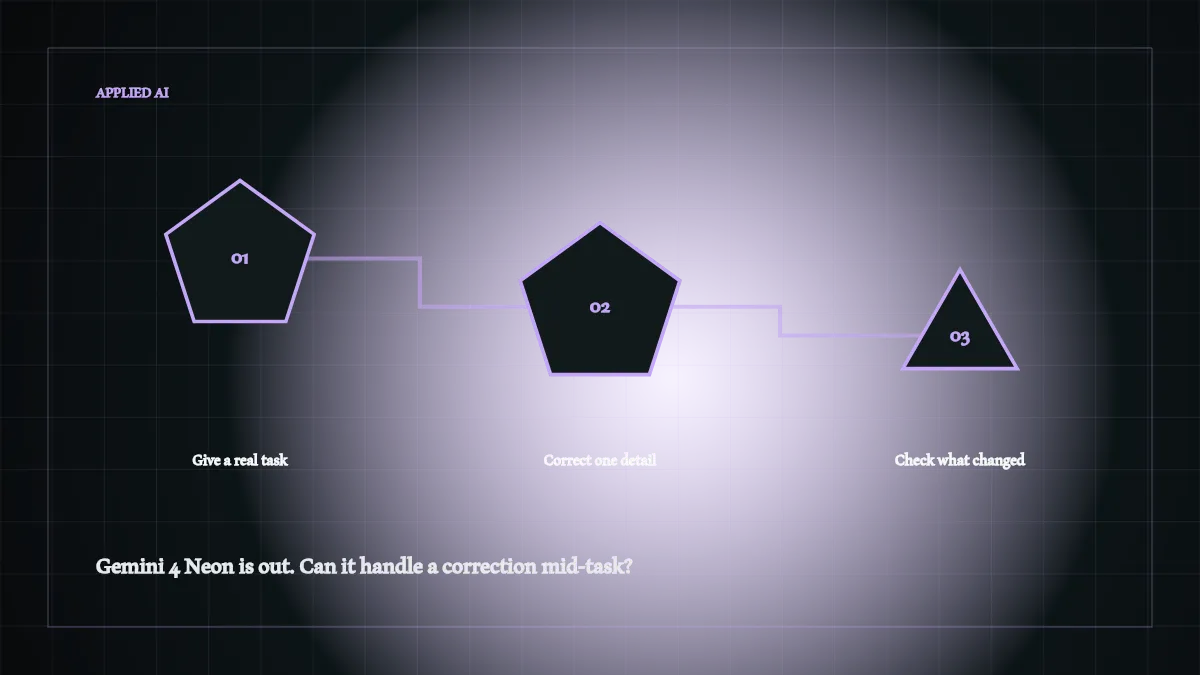
Google introduced Gemini 4 Neon on November 18, with rollouts covering the Gemini API, AI Studio and selected Gemini products and plans. The announcement highlights an unusually practical claim: the model can adapt when a user changes the brief after work has started.
Turn the claim into one familiar task
Give the model an anonymized monthly spreadsheet and a short brief for a report. After it outlines an answer, move one team from “sales” to “operations.” Ask it to revise the affected totals and explain which sections changed. The small correction gives a reviewer an outcome they can calculate independently.
Check which edits should propagate
The updated team total, overall total and any related chart caption should agree. A change that fixes the summary while leaving the chart caption stale still costs time. Record whether the model followed the new rule and whether it preserved unrelated conclusions.
Read the published score in its own setting
Google cites different reasoning settings and external evaluations in its launch announcement. A benchmark run at xhigh has its own conditions. For your job, compare elapsed time and the number of manual corrections with whatever model you already use. The API and the consumer app may offer different controls.
What to take away
A good real-world signal is one correction that lands everywhere it should, with the rest of the report still consistent.