Applied AI · Analysis
What to measure in a local gpt-oss pilot
Plan a limited gpt-oss pilot that records model variants, runtime overhead, task-level quality, and which parts of the system stay local.
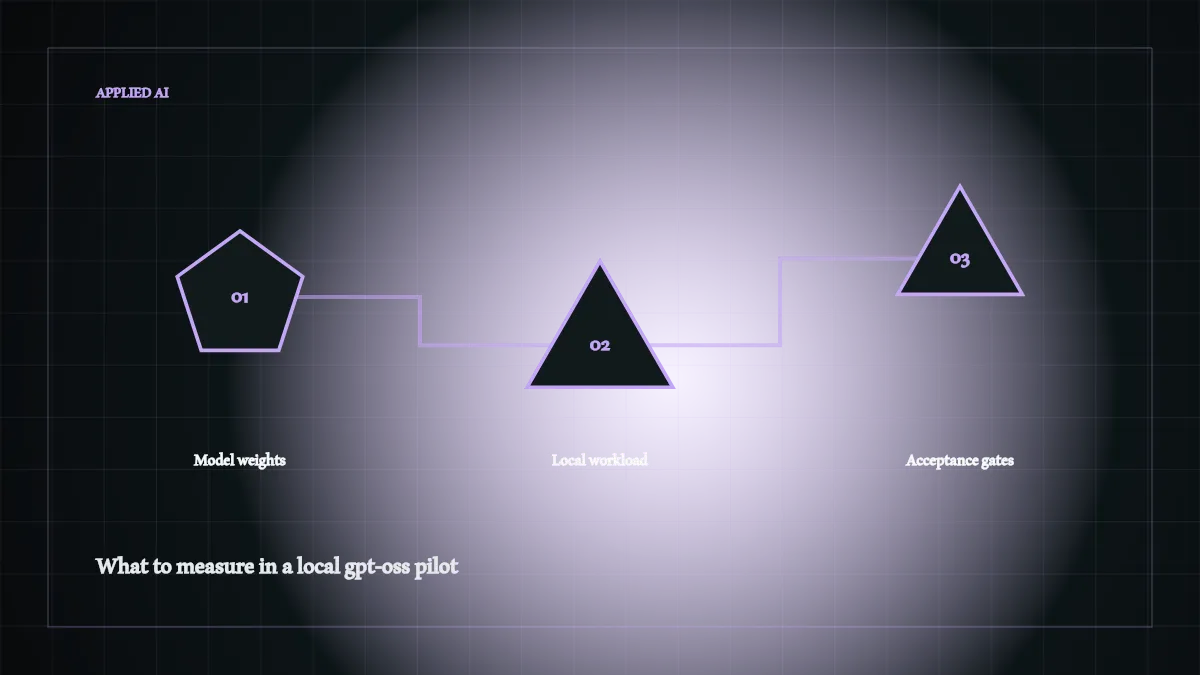
OpenAI published gpt-oss model weights in August 2025. A local deployment can give a team more control over where text goes and which version runs. Whether it can replace a hosted workflow depends on the real task and the cost of running it.
Write down what runs on the machine
The launch describes the 20b and 120b variants, an Apache 2.0 license, and alignment around the expected output format. Record the model artifact, quantization, runtime, GPU, context size, and any service called outside the process. Reproduce the setup from those notes before timing it.
Source · OpenAI — Introducing gpt-oss
Ask a domain question of the benchmark
A good labeler for five local categories may have little need for a broad reasoning suite. Feed the team’s edge cases and examples where it should abstain. Record quality alongside peak memory, queue delay at concurrent demand, and time to finish, for both short and long inputs.
Source · Liang et al. — Holistic Evaluation of Language Models
Draw a real data boundary
Inspect how inputs, outputs, crash logs, and any plug-ins behave during the pilot. Document where each is stored and decide how to handle an overloaded runtime or an unsupported request. If the fallback sends data to a remote service, the acceptance criteria need to cover that path too.
What to take away
An open-weight release gives you an artifact to deploy. Acceptance belongs to the complete workflow running under measured conditions.