Applied AI · Guide
A simple order-swap test for AI judges
Check whether an AI evaluator changes its preference when the same candidate answers trade places, and use disagreement to design human review.
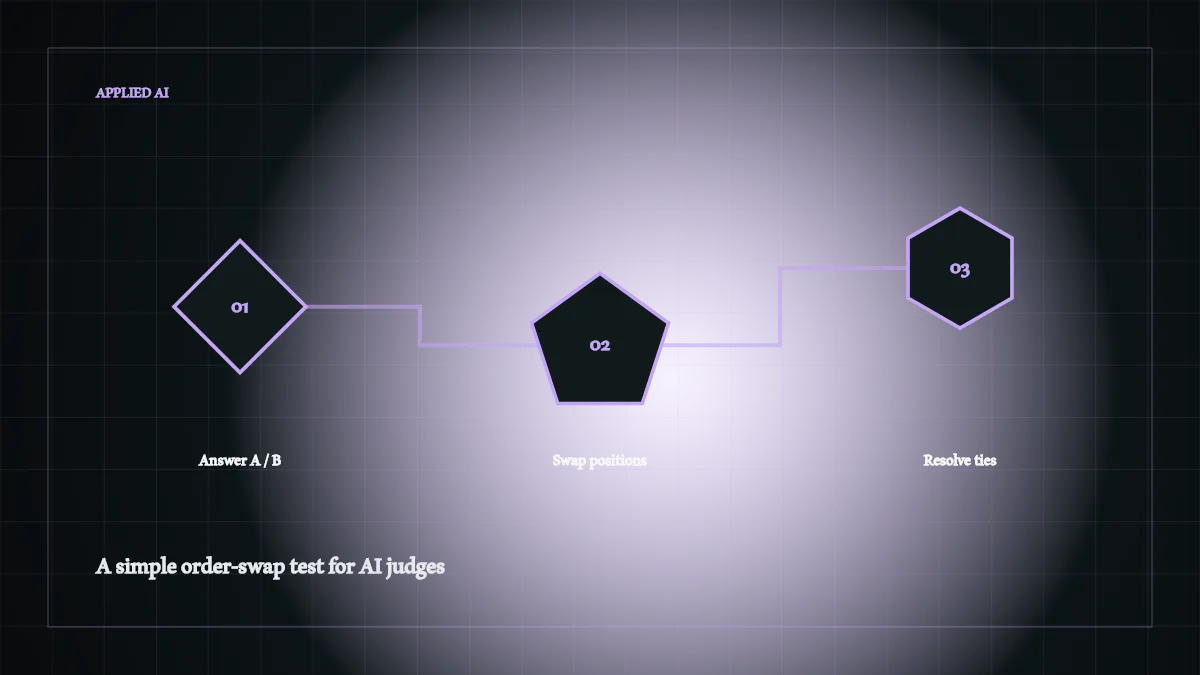
A user asks for a refund explanation, and two model versions give different answers. A language model can apply a scoring rubric to both. Its preference needs an audit, starting with something you control completely: which answer appears first.
Treat order as an experiment
The MT-Bench and Chatbot Arena paper tested position, verbosity, and self-enhancement biases in model judges. For each matched pair, send the same rubric once with answers A and B, then with B and A. Keep labels anonymous and map both scores back to the underlying answers.
Decide what a reversal means before scoring
Record agreement, an explicit tie, and an order-sensitive result separately. Add a synthetic pair with a concise factual answer and a longer one with an unsupported promise. Give each rubric item observable evidence and force a citation to the evaluated answer for any critical decision.
Source · Zheng et al. — Judging LLM-as-a-Judge · OpenAI API — Evaluation best practices
Spend reviewer time on disagreement
Route reversals, serious omissions, and close release decisions to a human who sees the task and rubric without a model label. Seed the next run with repaired examples from this review. Report the order-swap disagreement rate and the fraction requiring review alongside the overall winner count.
What to take away
An AI evaluator is most useful when its uncertainty creates a review case the team can inspect.