Blockchain research · Analysis
What Glamsterdam’s access lists change inside an Ethereum block
Read the Ethereum Foundation’s Glamsterdam testnet announcement through the lens of block-level access lists and client behavior.
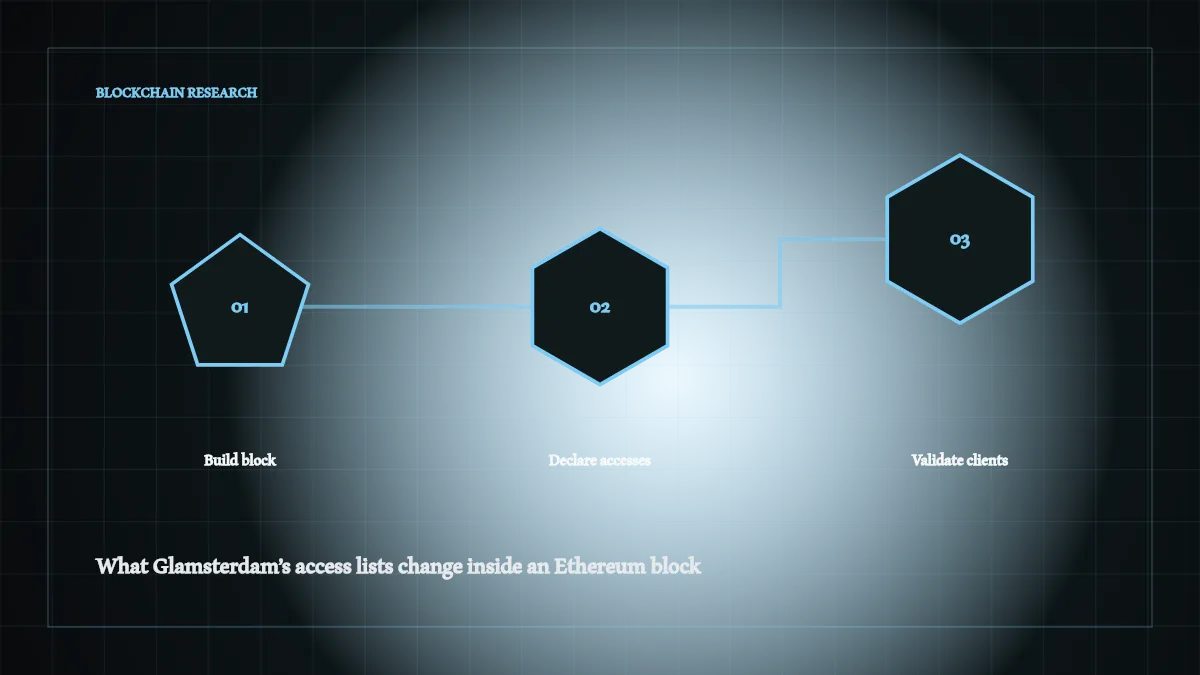
The Ethereum Foundation’s September 2026 announcement presented Glamsterdam as the upgrade following Fusaka. The publication described a testnet rollout and several protocol changes. One of the most concrete ideas for developers is a record of the state a block accesses and changes.
The block carries an access record
EIP-7928 describes block-level access lists that capture accounts and storage locations accessed, with state changes tied to transaction positions. The stated goal is to give clients structured information they can use for parallel reads and parts of validation.
Source · Ethereum Foundation Glamsterdam testnet announcement · Ethereum EIP-7928 block-level access lists
Parallel work can happen on the node
A client that knows which state it needs can organize fetching and some verification more efficiently. Application teams should still evaluate their actual workloads. The existence of an access list does not by itself promise a particular fee, throughput or transaction outcome.
Source · Ethereum Foundation Glamsterdam testnet announcement · Ethereum EIP-7928 block-level access lists
Read related gas changes separately
The same announcement discusses changes to account for state creation and access more explicitly. For a contract-heavy application, benchmark representative writes and reads against the targeted testnet, and log failures along with gas measurements.
Source · Ethereum Foundation Glamsterdam testnet announcement
What to take away
Use the announcement as a checklist of what to test. Record the network and client versions, especially when a result is based on a testnet.